
Field Notes on Client Readiness
Observations from clinical work where compliance alone didn’t explain outcomes.
These notes document a pattern I kept seeing —patients who were motivated, compliant, and improving on paper,yet still flared, disengaged, or disappeared.
They are not conclusions.They are observations.
Field Note 1 — Drop-off is usually silent
Most patient drop-off isn’t confrontational.
It doesn’t come with refusal or complaint.
It comes after early improvement.
After increased effort.
After subtle changes in breath, tone, or tension.
By the time non-compliance is visible, the system has often been signaling for weeks.
Field Note 2 — Effort can mask readiness gaps
Increased effort often looks like engagement.
Physiologically, it can be the opposite.
Bracing, breath-holding, and urgency can temporarily hide overload —until they can’t.
Compliance can coexist with poor readiness.
Field Note 3 — The freeze-frame moment
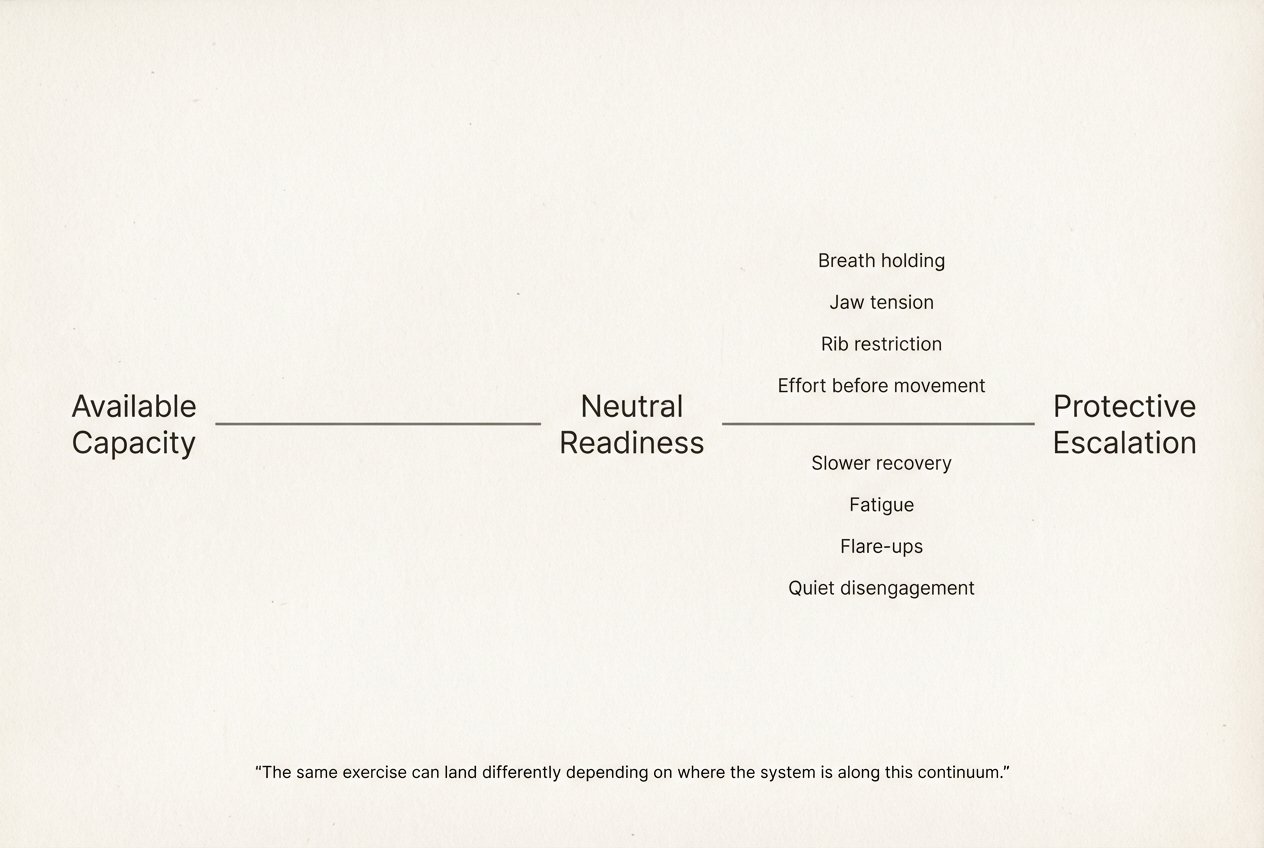
There is a moment before movementwhere the outcome is already set.
You can see it when:
- the breath pauses
- the jaw tightens
- the ribs lock
- effort precedes motion
This moment predicts flare-ups better than exercise selection.
Field Note 4 — Education doesn’t resolve protection
Education supports understanding.
It doesn’t reliably change physiological readiness.
Many patients understand the plan and still can’t receive the load.
Readiness is not agreement.
What this lens changes
Viewing drop-off through readiness shifts attention:
From motivation → capacity
From persuasion → timing
From fixing → noticing
Not to do less —but to intervene when the system can actually respond.
A necessary boundary
This lens does not replace clinical reasoning.
It adds a layer that was often assumed rather than assessed.
It does not tell you what to do.
It helps you see when something is premature.
Where this leads
These observations eventually became the foundationfor a structured exploration called the Client Readiness Lab.
The Lab is not always open.When it is, it builds slowly from these same notes.
No obligation. One notice when relevant.

Client Readiness ©
Professional education for physical therapists
Questions?
hello@clientreadiness.com
Developed by James Ko, PT
Learn more about James Ko on LinkedIN
Copyright 2026
Privacy Policy | Terms of Service | Contact